Clarity By Design
The Two Insights that Drive Everything
Most families do not lack information. They do not lack advisors. What they lack is clarity about the whole system. How everything connects. Whether the structure around their wealth is actually serving the family or quietly working against it.
That gap is where problems start. It is also where Clarity by Design begins.
First - There is a profound difference between managing wealth and controlling it.
Most families have good advisors. An investment advisor managing the portfolio. A CPA handling tax. An attorney managing the estate plan. An insurance agent managing risk. An accountant managing the entities. Each one is good at their job. Each one is giving advice that is genuinely the right call from where they sit.
That is the problem.
Best from the investment advisor's perspective is not always best from the CPA's perspective. A tax efficient move can create a liquidity problem. An estate structure built for one purpose can create friction for another. Each advisor is optimizing their piece. Nobody is optimizing the whole.
That is what it means to have wealth that is managed but not controlled. The pieces are being handled. The system is not.
A family office executive does not replace any of those advisors. The investment advisor still manages the portfolio. The CPA still handles the tax work. What changes is that someone now sits above all of it, sees how the pieces connect, and makes sure the advice from one area is not quietly working against the advice from another.
That is the difference between managing wealth and controlling it.
Second - The Center of Gravity Shift
The second insight explains how that control gets lost in the first place, and what it takes to get it back.
Here is what changes in practice.
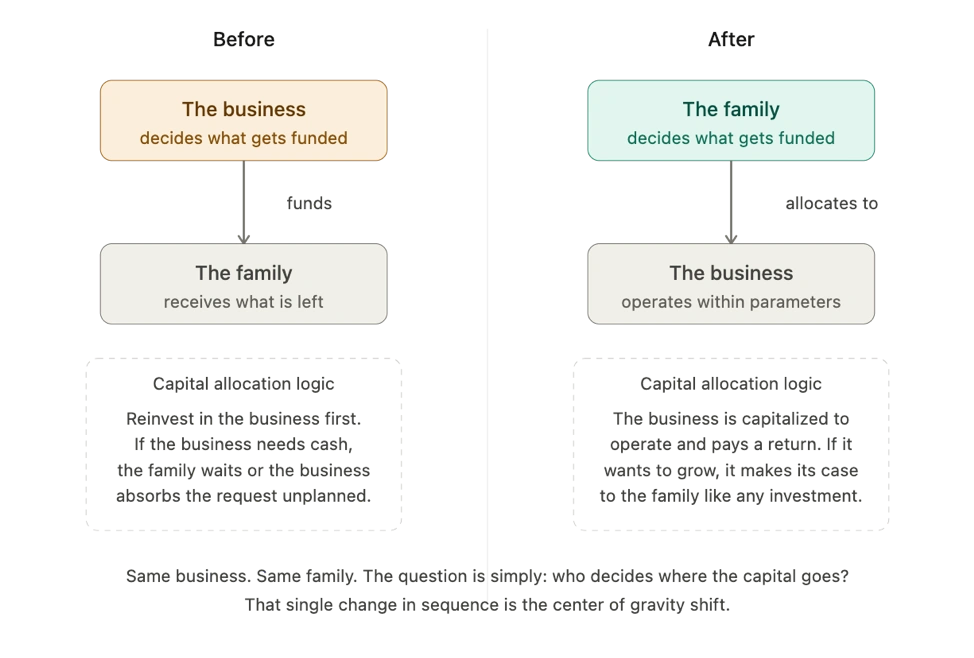
Before the shift, the business sits at the top of the decision making structure. It decides what gets funded first. Capital gets reinvested in the business because that is what built the wealth and that is what feels right. The family receives whatever is left over. And if the family needs something the business did not plan for, the business absorbs that request unexpectedly, often without anyone calling it what it is.
After the shift, the family sits at the top. The family decides where capital goes. The business is capitalized to operate and is expected to perform, paying a return like any other asset in the portfolio. If the business wants to grow beyond its current capitalization, it makes its case to the family, the same way any other investment opportunity would.
Same business. Same family. The only thing that changes is the sequence. Who decides where the capital goes first.
That single change in sequence is the center of gravity shift.
For operating families, this means the business transitions from being the family's identity to functioning as an investment. For liquidity families, the shift moves from one person being the center of every decision to a governance structure that can outlast any individual. The expression is different.
The need is the same.
This shift does not happen by accident. Most families do not realize it needs to happen until they are already feeling the friction of operating without it.
A family does not need more disconnected advice. It needs a system.
The Framework brings purpose, governance, capital, risk, family dynamics, and decision-making into one structure so the family can move from reaction to intention.
The Three Stages of Clarity
Every engagement moves through three stages. The sequence matters.
Stage One is operations and infrastructure. Before anything else the basics have to work. Reporting, workflows, staff, controls. This is the unglamorous work that makes everything else possible.
Stage Two is tactical risk and investment. Making sure what exists is appropriate and efficient. Financial risk, physical security, investment strategy. Getting everything pointed in the same direction.
Stage Three is governance and strategy. Where the real transformation happens. Decision frameworks.
Generational planning. Long term strategy built around what the family actually wants their wealth to do across decades not just quarters.
Most families want to start with Stage Three. It only works once the first two are solid.
Clarity does not happen all at once...
It happens in order.
Foundation first
Then alignment
Then transformation
Skip a step and the next one will not hold.
The Center Of Gravity Shift
Copyright © 2026 The Family Office Guy - All Rights Reserved.
This website uses cookies.
We use cookies to analyze website traffic and optimize your website experience. By accepting our use of cookies, your data will be aggregated with all other user data.